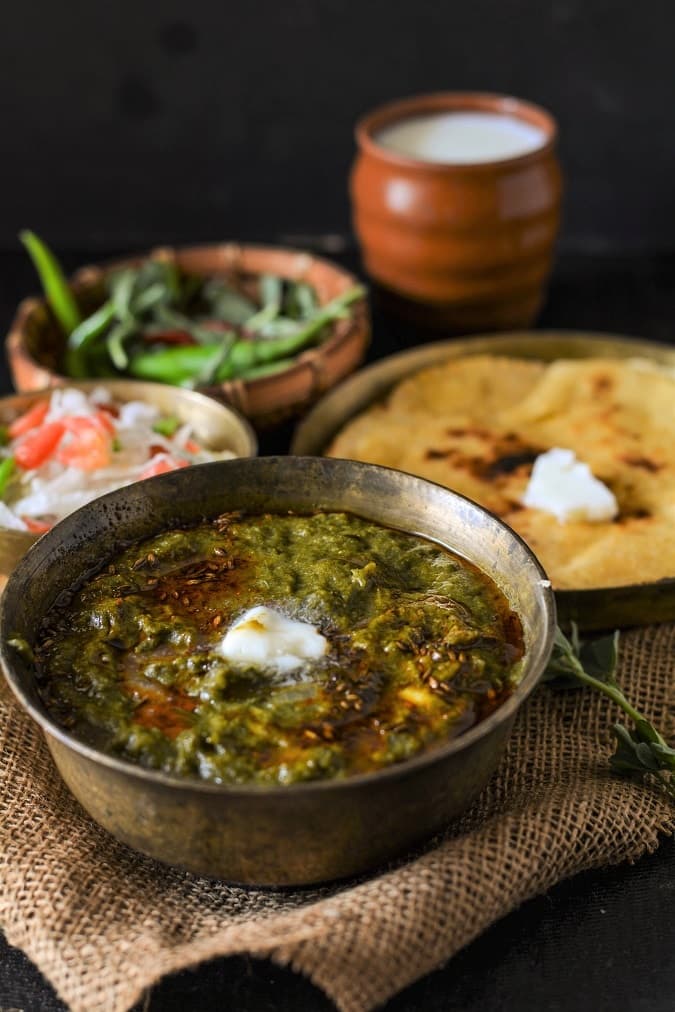
Nourishing ourselves is much more than eating, just as breathing is much more than inhaling and exhaling. It is one of those activities that accompanies us throughout our lives, from beginning to end. Although it is directly connected to the sense of 'taste' — one of the most real and joyful experiences we have continuously — it also involves smell, sight, touch, and hearing. One of the many dishes I could share here is 'Sarson ka Saag' — which would commonly be translated as 'mustard greens curry'.
In homes across India, it is common to hear the sound of clean mustard leaves, spinach, lamb's quarters, and fenugreek being finely chopped using a 'darati'. This mixture is then boiled in a pot (or pressure cooker) with water until it is thoroughly cooked and no longer watery. You can use a blender or simply stir it patiently with a ladle; a little cornmeal is added and it is simmered until it thickens slightly. This is the Saag.
The next step in this process is one the nose senses first, with the eyes close behind: cumin seeds are dropped into a pan of hot ghee (clarified butter) to toast. Then red onion, garlic, green chili, and ginger — all finely chopped — are added and cooked until lightly golden. Salt, turmeric, and garam masala (a blend of many spices) are stirred in to taste. Chopped tomatoes go in next and everything is left to simmer until well combined.
We pour this curry into the Saag and let it simmer together for a couple of minutes. Once turned off, we scatter in some finely chopped coriander leaves and cover the pot. You can add a spoonful of ghee before serving and enjoy it with roti, chapati, or a corn or wheat tortilla.
Yet, before eating, you remember:
Annaṁ Brahma Raso Viṣṇuḥ Bhoktā Devo Maheśvaraḥ / Food is the Force that Creates, flavor is the Force that Sustains, and the one who eats is the Being itself.
Yogendra Sharma / Delhi, India